Many entrepreneurs dream of starting their own business and want to make it a reality. But there are a number of hurdles that need to be taken into account when setting up a company. In Germany, these include, above all, the issue of taxes, which entrepreneurs should not underestimate. This is because there are numerous taxes in Germany and other countries, such as VAT, trade tax and corporation tax, to name just a few types of tax.
In this article, you will learn the basics you need to know about VAT.
What is sales tax?
Value added tax (VAT) is used to tax consumption. For you as an entrepreneur, this means that VAT is added to the price of every sale and paid by the end consumer with the invoice. The entrepreneur pays the VAT to the tax office.
In Germany, the tax rate for almost all consumer goods is 19%. However, some everyday products, such as food or books, are subject to a reduced tax rate of 7%.
Entrepreneurs who do business in other countries must pay attention to the tax rates applicable in their country. Outside of Germany, you will often come across the English term for sales tax: VAT (Value Added Tax).
What is subject to VAT?
All of a company's sales that are carried out in Germany are generally subject to VAT. This is also referred to as taxable turnover.
This includes the following:
- Deliveries, such as sales of goods
- other services, for example services
Are there also tax-free sales?
There are also sales that are exempt from VAT in Germany.
This includes the following, for example:
- Sale, letting and leasing of real estate
- Turnover from work as a doctor, dentist, alternative practitioner or midwife, but not turnover from work as a veterinarian
- Turnover of certain cultural, general education or vocational training institutions (such as schools)
Interesting facts:
- As a small business owner, you may be exempt from VAT in Germany
- Sales tax is one of the types of transaction tax
- Instead of sales tax, the term value added tax (VAT) is often used in common parlance. Sales tax is the legally correct term.
When do we start talking about entrepreneurs?
If you are self-employed in a commercial or freelance activity and generate income from it, then you are an entrepreneur.
This means, for example, that if you provide services or sell goods and charge a fee for them, you meet the requirements for a commercial or freelance activity. It does not matter whether your activity is carried out regularly or only occasionally, or whether you make a profit.
What does an invoice with VAT look like?
The creation of a proper invoice plays an important role for entrepreneurs.
An invoice is any document with which an entrepreneur invoices a service to a recipient. Accordingly, a contract can also be regarded as an invoice.
The following illustration shows the most important elements that an invoice with VAT must contain.
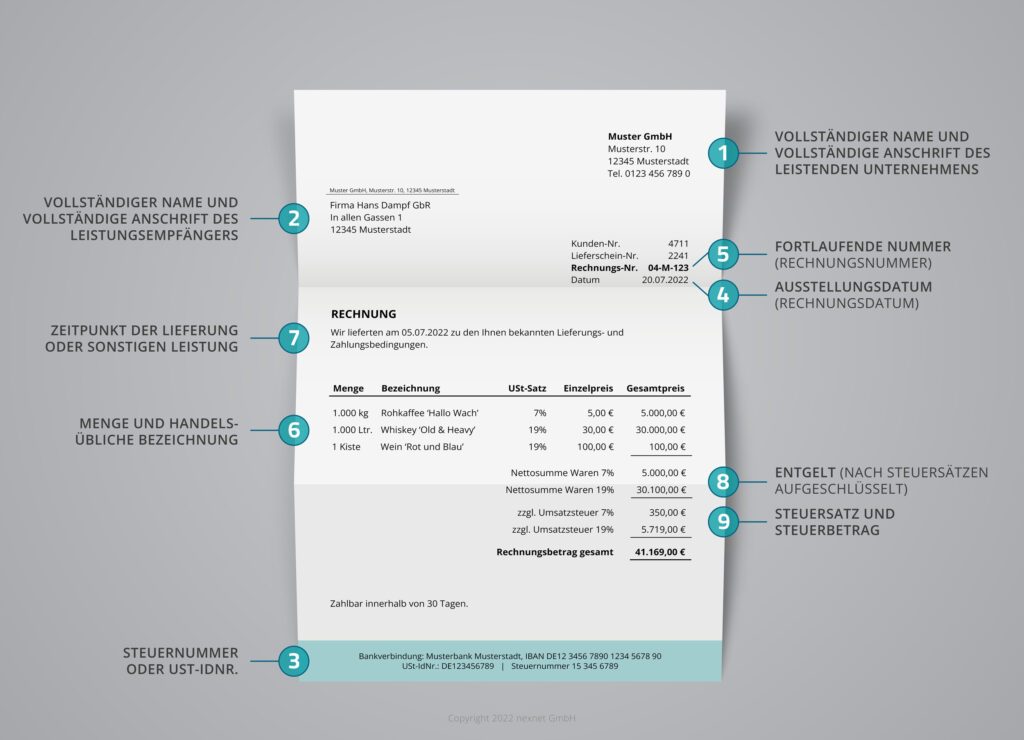
These points must include a proper invoice (over €250):
- Full name and address of the entrepreneur providing the service
- Full name and full address of the beneficiary
- Tax number or VAT ID no.
- Date of issue (invoice date)
- Consecutive number (invoice number)
- Quantity and commercial designation
- Time of delivery or other services
- Remuneration (broken down by tax rates)
- Tax rate and tax amount
A proper invoice for an amount under €250 does not have to contain all the items listed above. For this type of invoice, it is sufficient to state the full name and address of the entrepreneur providing the service. Furthermore, the date of issue (invoice date), description of the service, as well as the remuneration and the tax amount due on it must be stated as a total. The tax rate must also be shown on the invoice.
How can nexnet help?
With over 20 years of market experience in accounts receivable management, payment and payment clearing, invoices and, above all, mass settlements are part of our daily business.
With our manufacturing work, we can adapt to the individual needs of our customers and adapt our processes flexibly and reliably to every requirement.
Does your business model not only include EU member states, but do you operate worldwide? That's no problem. Our expertise also includes debit solutions for EU and non-EU countries.